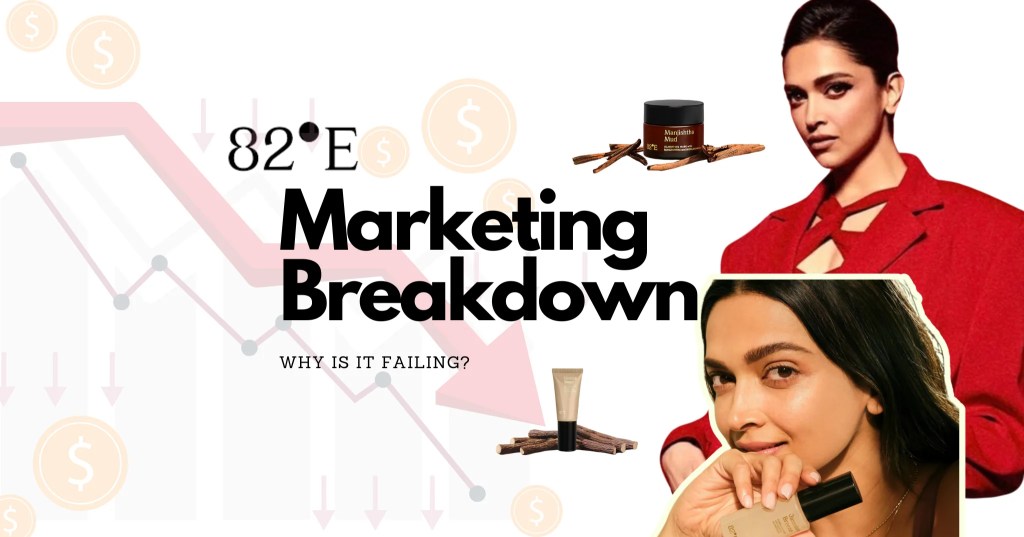
When Deepika Padukone announced her skincare label 82°E, there were a LOT of eyes on the new product. She’s a global celebrity, has a clean aesthetic, the brand’s wellness promise had all the makings of a smash hit. But somehow between the products dropping and the public receiving, all excitement dulled. So what happened?
Let’s break this down using a bit of marketing 101 and determine where the marketing for 82°E potentially fell short.
1. Overpriced Without a Clear Value Proposition
The first criticism? The cost.
The skincare space isn’t unfamiliar with influencer pricing but there was no clear explanation as to why 82°E charged what it did. In a crowded ingredient-led, science-led market populated with brands like The Ordinary or Dot & Key, “clean and effective” just wasn’t enough.
📉 Marketing miss: They relied on Deepika’s persona to justify price, rather than building credibility with product education and USPs.
2. Celebrity-First, Brand-Second
The launch seemed more like a “Deepika campaign,” rather than a skincare brand launch.
Sure, celebrity brands work but only if the focus is on the consumer, not the celebrity. Brands like Fenty Beauty work because they are solving real consumer needs. For 82°E, many consumers felt it was just another celebrity vanity project.
📉 Marketing miss: Heavy brand identity focused on Deepika, and little focused on user benefit or results, and absolutely nothing to differentiate itself.
3. Weak Community Building and Customer Engagement
Some things are simply non-negotiable for a modern D2C beauty brand. Community building is one of them. Take Glossier, for example. Customer reviews, memes, before-afters, TikTok challenges. All of those mechanisms build community. The community was non-existent with 82°E. The marketing felt one-sided; here’s our product, buy it.
📉 Marketing miss: UGC (user-generated content) was practically absent, influencers buzzed minimally, customers weren’t engaging, and momentum came screeching, and I mean screeching, to a halt.
4. Product Line Didn’t Offer Enough Variety or Innovation
Putting out a face oil and moisturizer in a highly competitive space just wasn’t daring enough, it was actually boring. We know consumers expect some newness, a solution for their skin type, and a sense of inclusion when it comes to beauty launches.
📉 Marketing miss: There’s not a unique hook or first-mover advantage. The portfolio seemed too safe for consumers to even be curious enough to comment on.
5. Poor Content Marketing and SEO Game
Skincare buyers are research-oriented people. They Google ingredients. They read reviews. They watch routines. This is where 82°E’ marketing missed the opportunity. Their website had little blog content, a small SEO footprint, and hardly any educational storytelling on any platform.
📉 Marketing miss: Missed opportunity to rank for skincare keywords, build trust with expert content, and set users on a path when researching the buyer journey.
6. No Cultural/Emotional Anchor
82°E’s name comes from India’s longitudinal center, but the brand never leaned into that position. The brand had a missed opportunity to emotionally anchor itself in Indian heritage, rituals, or natural beauty.
📉 Marketing miss: The brand name sounds smart but lacks a soul. There is no emotional or cultural story to root for.
7. Weak Product Marketing
Product marketing is the most essential position on any marketing team, product marketers sees all the new launches and upgradation and market it. Their launch did get a social media push, but it didn’t hold. There was no strong referral program, nothing too wild from PR and no campaigns that stood out. The brand faded into the wash of skincare is a wash.
📉 Marketing miss: There was no proper GTM launch strategy. After a month, it felt like marketing was either all over the place or had come to a halt.
8. Packaging Over Promise
The packing was awesome, simple, clean, Instagrammable. But in 2025, packing doesn’t sell skincare. People want proof, clinical trials, results, science, and customer reviews.
📉 Marketing miss: Great first impression, but nothing more, nor any substance.
What Could’ve Saved 82°E?
- Starting off with a solid hero product + proof from users
- Teaming up with trustworthy dermatologists or skincare experts
- Going ahead with a brand story based on Indian rituals or science
- Creating an authentic community with creators, reviews, and routine content
- Using Deepika’s global influence more smartly, beyond thinking of her just for a face
Can They Still Change the Picture…?
82°E can absolutely still go right. The brand isn’t dead, just disconnected. The skincare and wellness market is forgiving, if they course-correct with clarity, community, and customer value, there’s still plenty of room to win.
Final Say
Celebrity brands can work, if they’re built like real businesses, not just a label on a bottle. 82°E marketing has some major misses in the key building blocks of modern branding: authenticity, storytelling, community, education, etc. The audience didn’t reject the brand, they simply didn’t understand why they needed it.
If the brand revamps and connects with the skincare-savvy Gen Z and millennial market, there is still hope. But for now, 82°E from Deepika Padukone is a lesson that just because you have a celebrity does not mean you succeed as a brand.

 The Marketing Unplugged
Leave a comment